01
BCR Gasification
Biomass source → gasification energy → biochar → carbon removal, with useful-energy recovery.
AI data centers are moving from energy purchasing and efficiency into integrated governance of power resilience, residual emissions, embodied carbon, disclosure, and finance.
Its infrastructure value comes from being embedded into electricity, thermal management, waste treatment, materials supply chains, and carbon-data governance.
Executive summary
CDR may become infrastructure when it is designed as a durable, verifiable and financeable operating module—not when it is only purchased as an offset.
Power procurement, microgrids, backup, cooling, waste heat and carbon governance become one planning system.
BCR fits distributed park-edge use cases; BECCS/BiCRS fits regional hubs with transport and storage access.
The infrastructure case depends on MRV, durability, offtake contracts, accounting treatment and credible claims.
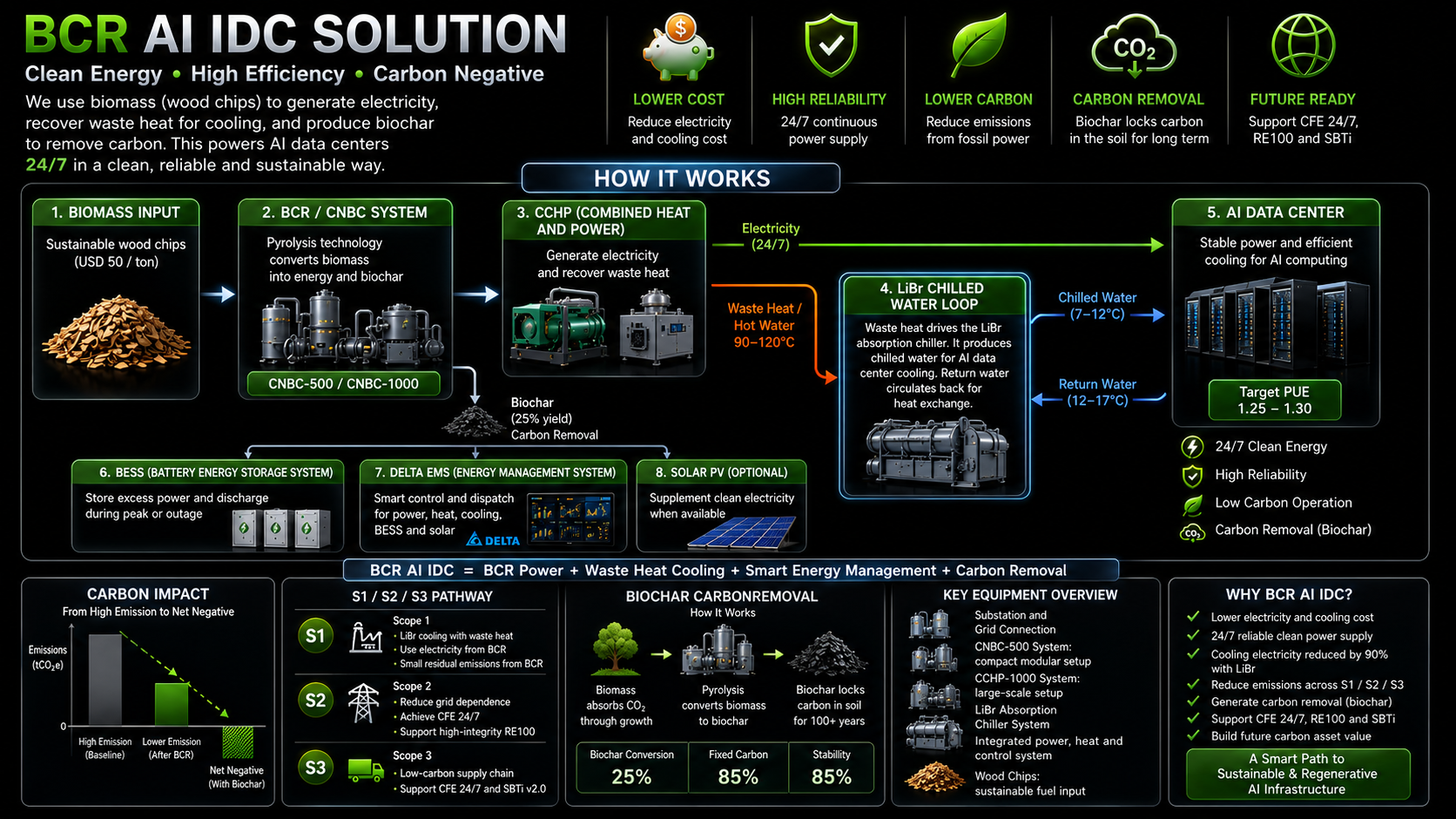
BCR connects feedstock logistics, pyrolysis, combined cooling heat and power, LiBr cooling and energy management into one operating platform.
Dispatchable energy and waste-heat-driven cooling for factories and AI data centers.
Stable biochar, quantified removal potential and long-term carbon storage.
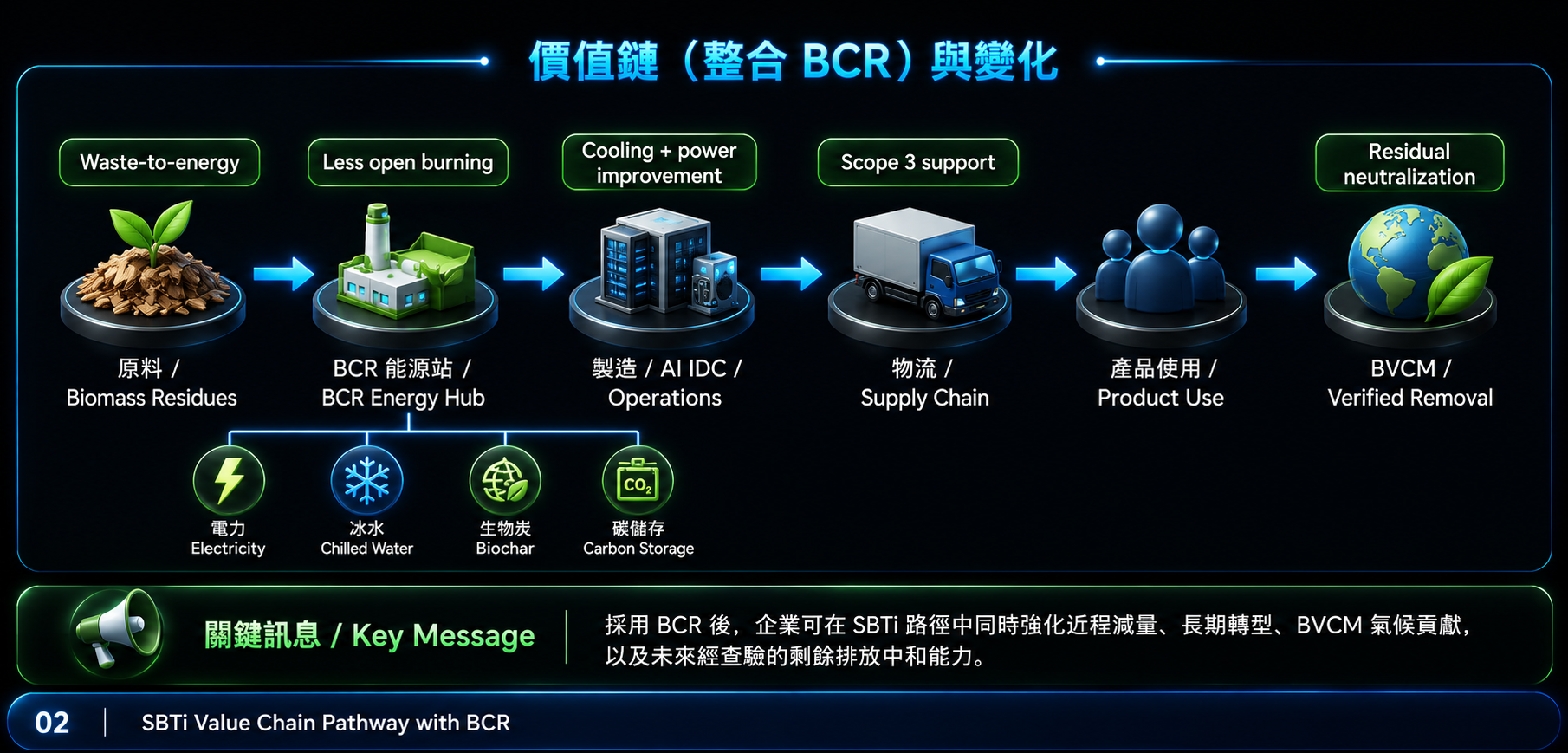
Transforms agricultural residues into useful outputs instead of open burning.
Supports verifiable net-zero claims and beyond-value-chain mitigation.
The physical and digital layers are designed as one infrastructure stack instead of separate stand-alone projects.
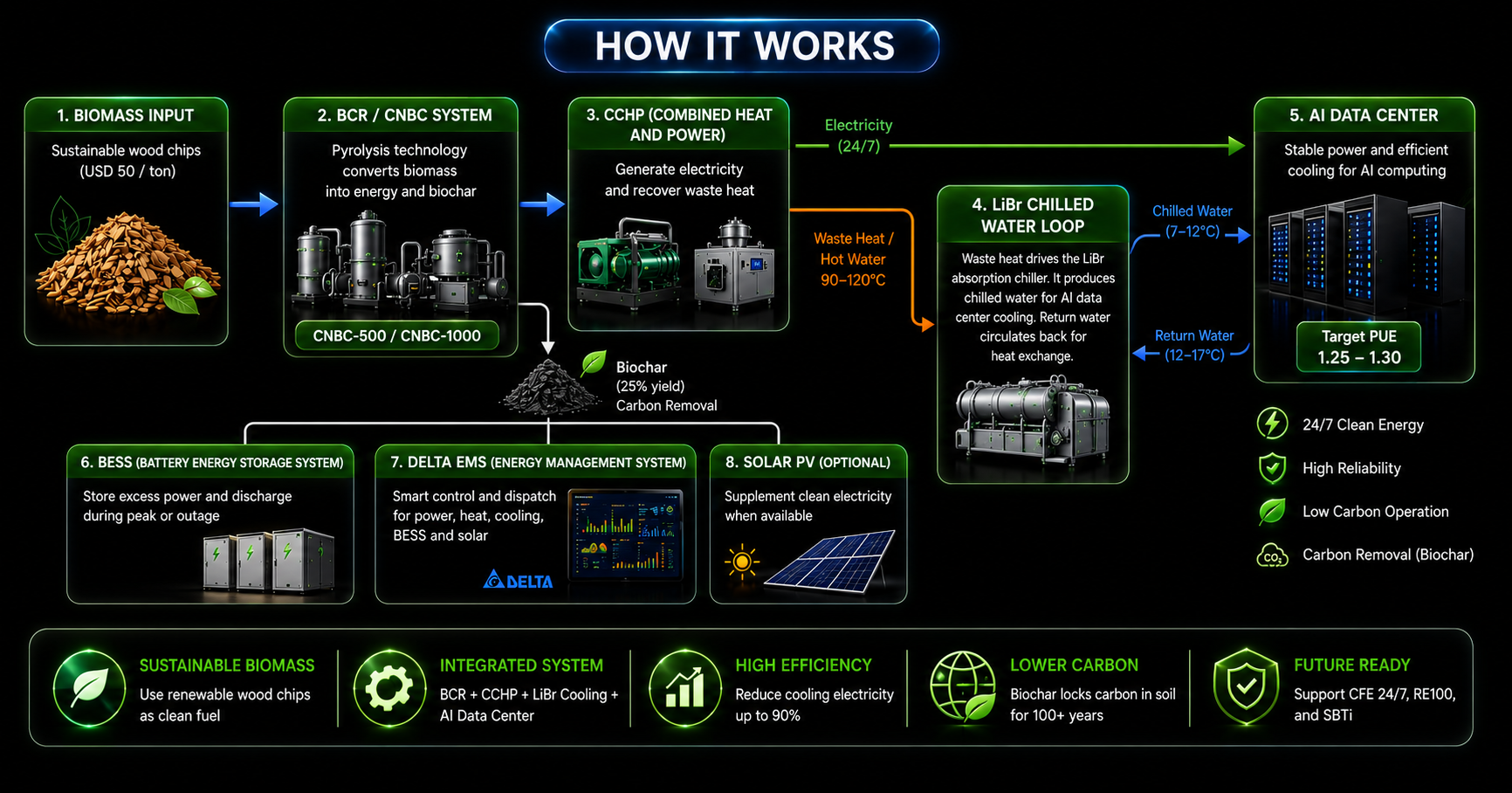
Biomass source → gasification energy → biochar → carbon removal, with useful-energy recovery.
Electricity, steam, hot water and residual heat support drying, production and absorption cooling.
Thermal energy drives low-electricity cooling for data centers, industry and commercial buildings.
Methodology, dMRV, registration, verification, issuance, buyer claims and risk control.
Operational resilience for high-energy industrial and AI workloads.
Auditable carbon data supports credible claims and asset creation.
A replicable operating model with stronger capital-market narratives.
CWTel delivers an auditable low-carbon data layer where energy, carbon, operations, assets and compliance are governed on the same axis.
IoT and process data
ISO / GHG / customer
Audit trail and third party
SBTi, customer and finance
Information-security protection
Controlled permissions and segregation of duties
Secure transmission and storage
Policy-aligned evidence retention and auditability
Technology & operations
| Pathway | AIDC fit | Energy / thermal integration | CO₂ pipeline dependence | Durability | MRV complexity |
|---|---|---|---|---|---|
| BCR / Biochar | Park edge, industrial zones, agricultural/industrial waste nodes | Pyrolysis can generate heat, gas and oil; can integrate with CHP or heat use | Low | Hundreds to thousands of years | Medium |
| BECCS / BiCRS | Regional CHP, WtE, ethanol/biogas, pulp and biomass hubs | Can provide electricity and heat; suitable for regional energy networks | High | Geological storage can exceed ten thousand years | High |
Cost ranges vary widely: biochar roughly US$10–345/tCO₂, BECCS US$15–400/tCO₂, DACCS US$100–300/tCO₂, and enhanced weathering roughly US$50–200/tCO₂ depending on assumptions and boundaries.
Finance & accounting
A self-built or equity-held CDR facility, pyrolysis equipment, capture/compression assets and local MRV hardware may follow PP&E logic. Simple carbon-credit purchases do not automatically become assets.
CDR facilities, interconnection, storage/transport and dMRV systems can support asset and leverage logic.
Power/heat sales, treatment fees, biochar/material sales, CDR certificates and MRV services reduce single carbon-price dependency.
AIDC / hyperscaler offtake, AMC and multi-year purchases improve bankability and valuation stability.
Regulation & market alignment
Disclose climate risks and opportunities that may affect cash flow, financing access and cost of capital.
Prioritize deep reductions first, then use permanent removals to neutralize remaining residual emissions.
Host-country authorization and corresponding adjustment matter when cross-border claims or OIMP/NDC uses are involved.
CBAM does not directly target data-center operations; EU CRCF may improve comparability and financeability of high-quality removals.
Deployment roadmap
Inventory residual emissions, build dMRV/registry interfaces, include power and embodied-carbon requirements in procurement, and test high-durability offtake.
Deploy BCR/BiCRS where local waste and heat use fit; otherwise sign multi-year BECCS hub contracts and assess Article 6 / CRCF compatibility.
Govern low-carbon compute with 24/7 clean power, durable removal coverage, authorized credit share, MRV audit pass rate and embodied-carbon intensity.
The next step is not to debate which pathway sounds most advanced. It is to align site conditions, MRV architecture, offtake demand and storage channels.
←Back to CWTel Main Website